
Barcelona, 30 July 2026 — This summer, many southern European countries face constant states of emergency due to water shortages, with around 30% of people facing permanent water stress across the region. 36% of people in Cyprus, and 32% of people in Greece reported difficulties accessing clean water in 2025, and in 2026, several Greek islands have entered states of emergency due to water stress. Many parts of the region are facing what the UN has termed ‘water bankruptcy’ – in which groundwater and aquifers reach a state of no return to normal levels.
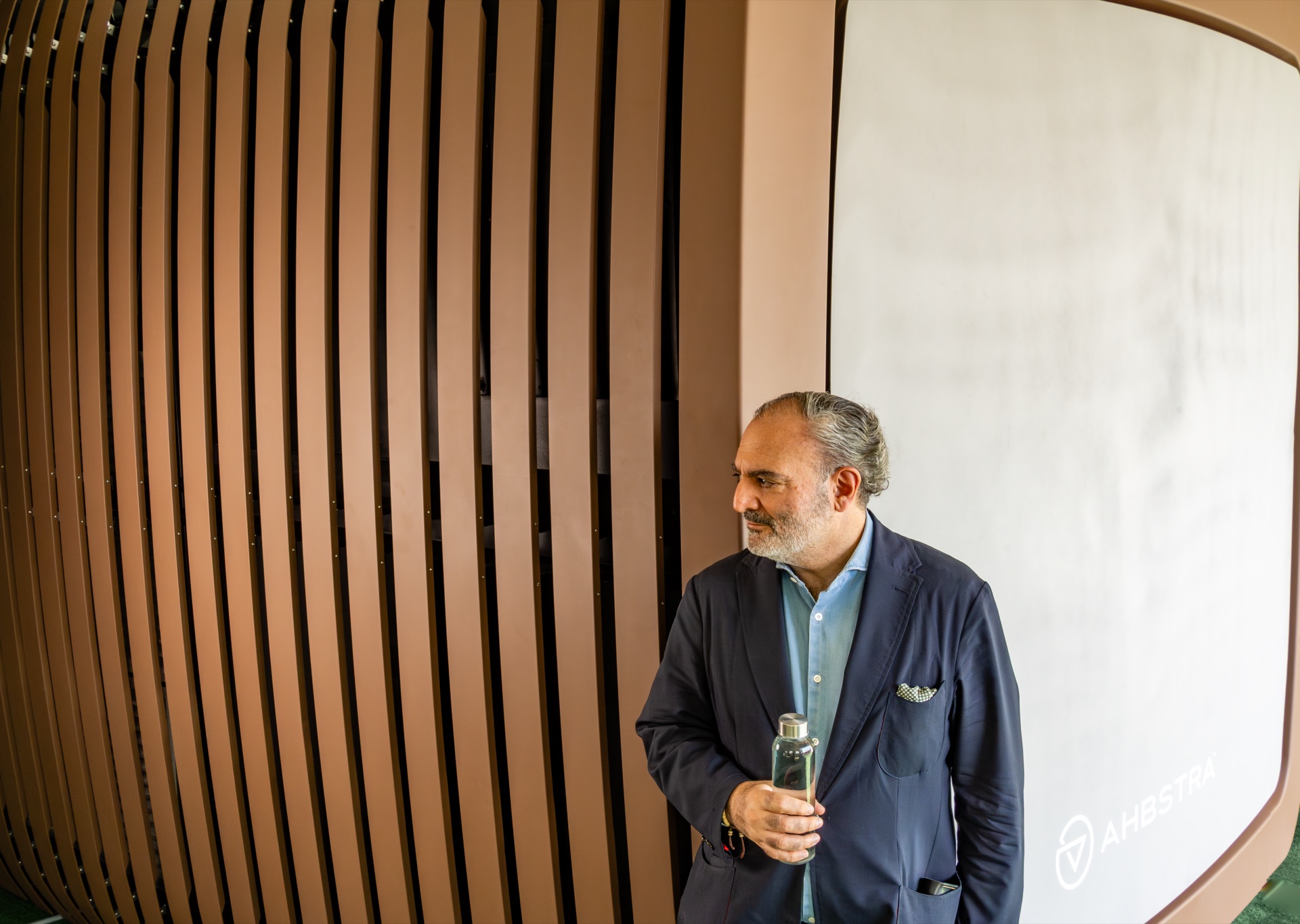
Responding to this crisis, and growing water stress around the world, Ahbstra, a UK tech company, has launched the ARK, a plug-and-play machine that harvests high quality drinking water from air at the rate of up to 500L/day even in dry and hot climates. This means the ARK can support a large household (the average European uses 144L of tap water per day). The ARK is the first commercially available water harvesting machine to be powered by MOFs to operate at this scale, and was demonstrated at an event in Barcelona, with the first purchased units due to be installed by early 2027.
A football pitch of surface area in a single gram
Ahbstra achieves this high output by using advanced nanomaterials known as MOFs (metal organic frameworks). These particles are engineered to have a huge internal surface area – the equivalent of a whole football pitch in one gram of material, which makes them ideal for capturing water or CO2 molecules from the air. MOFs were the subject of the 2025 Nobel Prize in Chemistry.
For more than a decade, researchers have argued that MOFs could transform atmospheric water harvesting, producing drinking water even in arid climates where other systems (such as dew-point technology) struggle. The chemistry has repeatedly shown promise in laboratories, but engineering a machine capable of producing meaningful volumes of water every day, at a feasible cost, has until now remained elusive. This is due to the challenge of moving vast quantities of air through the MOF hardware, and cycling through temperatures necessary to capture and release water.
Ahbstra’s patented solution, the Suspended Particle Reactor, cycles air through MOF granules in a fluidised state to maximise their performance, for the first time reducing energy requirements of MOF-based harvesting to commercially practical levels.
Built for the places wells are failing
The product is aimed at developers and owners of off-grid properties that currently rely on well water. In many regions around the world – particularly islands – wells are drying up or becoming unusable due to seawater intrusion, threatening the long term future of these places. This was the inspiration for the ARK, explains CEO Hashem Arouzi, when wells on his own property in Ibiza ran dry. The first customers of the ARK are largely located in the Balearics, where water scarcity is acute.
‘In Ibiza alone, there are over 15,000 properties that are not connected to the water supply, and need to secure their own water. The wells that have previously supplied them are running dry. For now, many of these property owners are reliant on water deliveries by truck, but these trucks need to fill up at reservoirs that themselves are running dry. Islands are developing desalination, but water from these plants will not be available to these properties. This reflects a global challenge; around the world there are millions of homes that are off-grid and water-stressed – in areas where existing methods of water harvesting would struggle with arid conditions,’ Arouzi commented.
Ahbstra also sees the southwestern United States and Middle East as areas where the ARK provides a lifeline to communities threatened by water scarcity. Countries around the world are grappling with this challenge – parts of Africa, Australia, South America and China also have areas of low humidity and high temperatures, where the ARK would play a vital role in tackling water stress.
‘The ARK guarantees a reliable, abundant source of water, anywhere. Water harvesting solutions on the market today face a critical limitation in that they only work in humid environments. This excludes most of the locations where they are needed most,’ Arouzi continues. ‘For years, MOFs have been a “magic material” on the cusp of delivering vital results for the environment, from water harvesting to carbon capture. We are the first to commercialise this technology and put MOFs into the hands of customers.’
Richard Perkin, CTO, commented:
‘It’s clear that weather and rainfall patterns are changing, leading to more extreme and prolonged drought conditions in many places. Tackling this requires a whole-system approach, from water efficiency to recycling and better infrastructure. Where we operate is at the source; if dams or wells are dry, they can only be refilled when it rains in the right place, no matter how responsibly the water is managed. This is why atmospheric water harvesting is a necessary part of the response.’
Price, power and what comes next
In many regions around the world, properties and developments are at risk of being devalued or abandoned if they cannot demonstrate independent water security.
The ARK is currently priced at £150k and produces water at an average cost of 20p per litre. Operating in a typical Southern-Mediterranean climate consumes around 10kW of power, and many customers are installing it alongside solar to meet this need. Water from the ARK can be used to replenish wells and cisterns, or be sent directly to a property’s mains water system.
The ARK produces high quality drinking water free of PFAS chemicals and microplastics which are commonplace in both tap and bottled water.
Ahbstra is scaling up production of the ARK in Barcelona, and is also developing systems for smaller water volumes. To date Ahbstra has raised £7m from a select group of family offices and key strategic corporate distribution partners, and is building towards a series A investment round.
‘This is just the beginning,’ says Arouzi. ‘We are seeing new formulations and applications of MOFs develop every week. Our Suspended Particle Reactor unlocks the performance from these materials that so many have been waiting for.’
Notes to editors
Founded in 2019, Ahbstra is a UK-based climate tech company building advanced machines that tackle critical environmental challenges, starting with water scarcity. Our patented technology releases the full potential of breakthrough molecular chemistry in the field of Metal Organic Frameworks (MOFs). We use our engineering focus to turn novel science into durable, elegant, high-performance technology that delivers sustainable and self-sufficient access to fresh water, even in the driest regions of the world.
We imagine a future where water independence is standard, and where every home, community and development can thrive in any climate. Our first commercial product the Ahbstra ARK, launched in 2026, is the world’s first plug-and-play MOF-based machine that can generate up to 500 litres of drinking water a day, enough to meet the needs of a typical family home. But that’s just the start; we are actively developing solutions to help solve water scarcity in different environments, and across various industries.
Our core engineering breakthrough also offers a path for MOFs to viably capture carbon from the air at scale, so we are investing in research and development into new solutions that could help address a root cause of water stress and climate instability.
References:
European Environment Agency – Use of freshwater resources in Europe
European Environment Agency – Overheated and underprepared
For media enquiries please contact ahbstra@diffusionpr.com

